Restlessness of the Americans over reopening the Strait of Hormuz
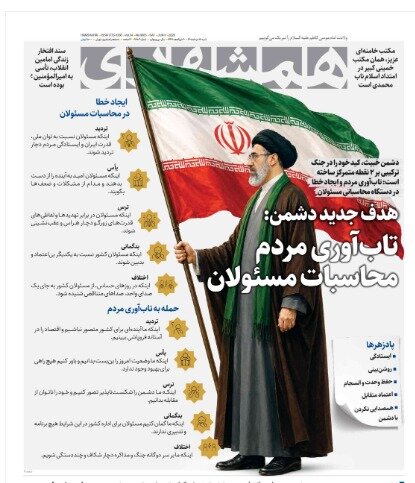
Hamshahri, in an editorial, examined the growing impatience of American officials regarding the reopening of the Strait of Hormuz. The continued closure of the Strait of Hormuz has become the central point of contention between senators and Marco Rubio, and the patience of US political elites with the economic, security, and strategic consequences of the Trump administration’s military adventurism is wearing thin.
Marco Rubio, in his first appearance before senators after the US–Israeli war against Iran, attempted to defend the Trump administration’s military approach. The sharp criticisms voiced by lawmakers about the Iran war, the Strait of Hormuz, the costs of the conflict, and the failures of diplomacy not only exposed deep rifts in Washington’s foreign policy but also signaled the end of patience among segments of the American political elite regarding the economic, security, and strategic fallout of Trump’s military adventurism.
Resalat: A three‑layer strategy for the Strait of Hormuz
Resalat highlighted Iran’s position on the Strait of Hormuz and the reasons why maintaining this stance benefits Iran and the Resistance Axis. Tehran has gradually made clear in recent months that its approach to the Strait of Hormuz is a three‑layer strategy, not a simple reactive measure. First layer: separating the nuclear issue from Hormuz. Iran understood that if the US lost its energy‑pressure leverage, it would also lose its main tool for extracting nuclear concessions. Second layer: asserting sovereignty over Hormuz as a long‑standing historical claim. Third layer: maintaining the current conditions through mine‑laying. Iran’s position has a clear logic: as long as Hormuz remains closed, energy pressure on the US economy continues, Trump comes under domestic pressure to reach an agreement, Iran sets a ceasefire in Lebanon as a condition, Israel is forced to withdraw from southern Lebanon, and Hezbollah gains the opportunity to rebuild. Iran successfully linked the ceasefire with the US to a ceasefire in Lebanon—showing how central Hezbollah’s fate is to Tehran.
Shargh: We need serious, direct, and genuine negotiations
In an interview with Shargh, senior international‑affairs analyst Mehdi Zakerian assessed Iran’s current approach to negotiations. According to Zakerian, what is needed more than anything today is serious, direct, and genuine dialogue. A model in which a third country merely exchanges messages between the two sides cannot replace real negotiations. Real negotiation means that representatives with broad public legitimacy in Iran sit directly across from the opposing parties, list all points of disagreement transparently, and discuss them openly. Therefore, the current negotiation method is far from what could be called a real negotiation. One cannot even expect this process to yield an outcome comparable to the JCPOA because Trump is seeking a form of submission, not a balanced agreement. Under current conditions, what is being discussed is less a comprehensive, balanced deal and more a limited transaction in which some restrictions are eased in exchange for the lifting of certain pressures.
Arman‑e-Melli: A new knot in Iran–US negotiations
Arman‑e-Melli analyzed a new complication in Iran–US negotiations. Financial compensation has become one of the most important points of contention between Iran and the United States—an issue that, according to informed sources, is particularly sensitive for Trump. Trump wants any potential agreement with Iran to be perceived as far stronger than the 2015 nuclear deal under Obama, and he seeks to avoid anything that might resemble that agreement. US officials worry that releasing Iranian assets at this stage would eliminate—or at least weaken—one of Washington’s most important leverage points over Tehran. They argue that maintaining this pressure is essential for entering the second phase of negotiations. Given that Iran is unlikely to accept any agreement lacking financial compensation, US officials acknowledge that the issue is not only financial and operational, but also tied to how it is presented and communicated publicly.
Siasat‑e-Rooz: IAEA’s double standard
Siasat‑e-Rooz evaluated Rafael Grossi’s recent remarks against Iran, writing that the IAEA and Grossi have once again shown they lack independence and continue to whitewash attacks on Iran’s nuclear facilities while producing reports that justify future hostile actions by the US and Israel. Therefore, maintaining intelligent management of the Strait of Hormuz and continuing certain inspection restrictions can be part of Iran’s response to such behavior. The IAEA and its director general—who have twice paved the way for military aggression against Iran, including attacks on nuclear sites—have again refrained from condemning these violations, effectively enabling their repetition. The agency’s biased double standard becomes clear when Grossi, after visiting the Barakah nuclear plant in the UAE, described attacks on nuclear facilities as completely unacceptable and a serious threat to international security, while he has consistently refused to condemn attacks on Iran’s nuclear facilities.
Leave a Comment